Why is Pluto not a planet?
1. Why is Pluto no longer a planet?
The reason why Pluto is not a planet anymore is because the International Astronomical Union (IAU) revised the definition of a planet during its 26th General Assembly in Prague in August 2006.
So what led this reclassification? Prior to the decision, Astronomers had discovered objects as big or bigger than Pluto in the solar system (e.g., 2003 UB313 now named as Eris). Without a new definition, there would be many Pluto-like bodies counted as planets and the number would keep growing.
You may wonder why not just call these objects planets too? In principle, we could. Some renowned planetary astronomers like Alan Stern and other colleagues favor a definition that would include Pluto as a planet (and they have their reason to do so, I will talk about this later). One of the issue would be that we would rewrite school textbooks every year. Having a clear definition helps scientists describe objects in a way that matches how they behave. Think of it like biology. We have categories like animals, plants, fungi, bacteria. Each category tells us something about how the organism lives and evolved.
2. What is a planet?
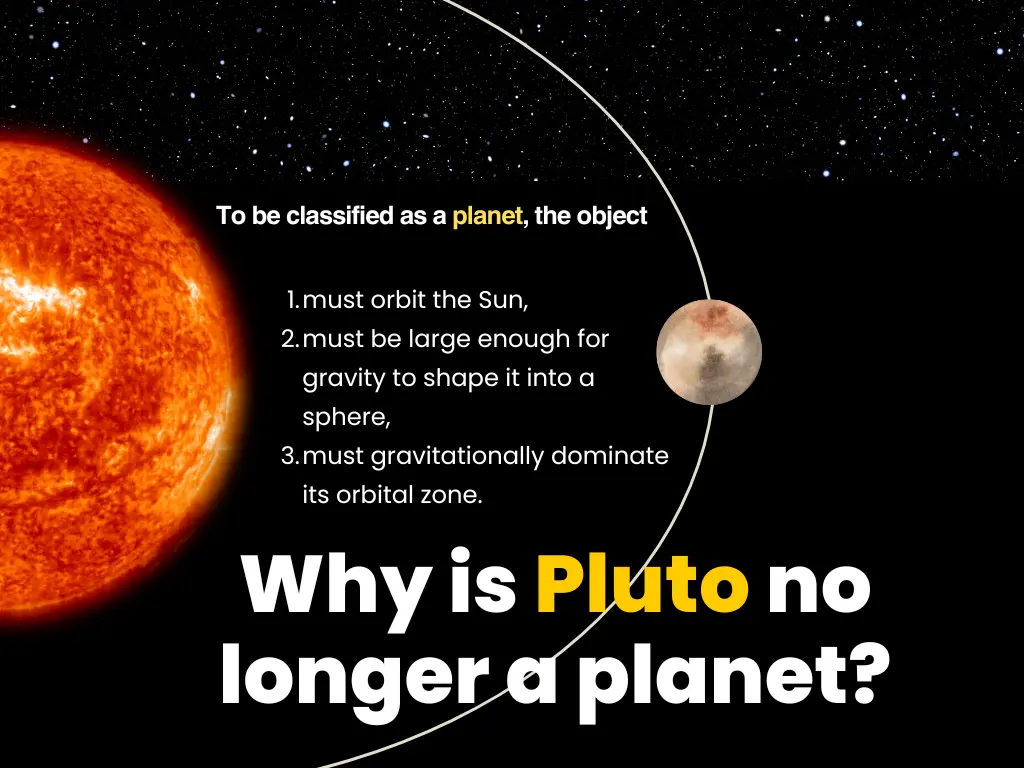
When I was in primary school, I was taught that Pluto was the ninth planet. If you were born before the late 1990s, you learned the same thing and probably still remember it that way. On August 24, 2006, the IAU passed Resolution B5-B6 at its 26th General Assembly in Prague. For the first time, astronomers had a formal definition of "planet." A planet in our solar system must satisfy all three of the following conditions:
- It must orbit the Sun (not another planet or some other object).
- It must have enough mass for its own gravity to pull it into a nearly round shape.
- It must gravitationally dominate its orbital zone.
3. Pluto is not massive enough to clear its orbital neighbourhood
Pluto orbits the Sun. It is massive enough to be spherical but shares its orbital region with thousands of other icy objects in the Kuiper Belt. Eris, for example, is more massive than Pluto. Thus, it fails the last criteria I mentioned previously. This is why Pluto is not a planet anymore.
Note that being gravitationally dominant does not mean that the region around its orbit is completely empty. For example, the Earth has thousands of near-Earth asteroids in its vicinity. However, the Earth's mass is overwhelmingly larger than all those asteroids combined, making it the dominant body in its orbital zone.
Pluto, by contrast, accounts for only a tiny fraction of the total mass in its orbital region. The Kuiper Belt contains many objects of comparable size, and Pluto has not gravitationally dominated them. That distinction separates planets from dwarf planets.
4. What is Pluto classified as now?
Pluto is now classified as a dwarf planet. According to the IAU, a dwarf planet is a celestial body that orbits the Sun, has enough mass to be nearly round, but has not cleared its orbital neighborhood (nor gravitationally dominant) and is not a satellite.
As of 2026, there are five dwarf planets: Ceres (in the asteroid belt between Mars and Jupiter), Pluto, Haumea, Makemake, and Eris (all in the Kuiper Belt). We expect more to be discovered.
Being a dwarf planet does not mean that Pluto is no longer interesting. NASA's New Horizons mission proved that Pluto is a geologically active and complex world, with mountains, glaciers, and possibly a subsurface ocean.
5. Common misunderstandings
Many people think that Pluto is no longer a planet because it is small. This is not true. The rule is about gravitational dominance, not size. You may also think that it is no longer important. Again, this is not true. Pluto remains one of the most scientifically interesting objects in the outer solar system. Scientists have proposed ambitious missions, which outlines a future Pluto-system orbiter designed to answer big questions about Pluto’s geology, atmosphere, and possible interior ocean. Some of the sciences they want to address include:
- Understand the internal structures of Pluto and Charon, including the evidence for a subsurface ocean on Pluto.
- Explain how surfaces and atmospheres in the Pluto system have evolved over time.
- Study how the Kuiper Belt Object (KBO) population has evolved.
The mission is scheduled to launch in February 2031, then pass close to Jupiter in May 2032 for a gravitational slingshot (the use of a planet’s gravity to change the speed and direction of a spacecraft, so it can travel farther without using as much fuel). After that, it is planned to carry out a Kuiper Belt Object flyby in February 2050, before finally arriving at Pluto in October 2058.
6. Not everyone agrees with the classification
As I have mentioned previously, not everyone agrees with the 2006 definition. Some planetary scientists argue that the new definition should be based on intrinsic properties, not orbital status. If Earth were placed in the outer solar system, it might not clear a much larger orbital zone either.
Alan Stern, the principal investigator of the New Horizons mission, has been one of the most vocal critics. Under his proposed definition, a planet is a body that has never undergone nuclear fusion and is massive enough for its own gravity to pull it into a rounded shape regardless of what else shares its orbit.
The IAU definition was adopted because of of a vote, but it was not unanimous (237 votes in favour, 157 against and 17 abstentions.) and the debate continues within the scientific community. Proposals for revised definitions have been discussed at other IAU meetings, though no changes have been adopted.
Comments (0)
No comments yet. Be the first to comment!
Leave a comment